How to Get Rid of an Oily Face: The Ultimate Skincare Guide
You blot your skin at mid-morning, reapply powder by lunch, and find your makeup sliding off your face by late afternoon. Dealing with constant facial shine can feel like a losing battle, leaving you wondering why your oil glands seem to be working overtime.
While excess sebum is one of the most common skincare issues, attempting to dry out your skin with harsh alcohols or abrasive scrubs almost always backfires.
Learning how to get rid of an oily face isn't about stripping your skin bare. It’s about understanding your skin's biological needs, balancing oil production, and selecting non-comedogenic ingredients that refine pores without causing irritation. Here is your complete, dermatologist-approved guide to achieving balanced, healthy skin.
Key Takeaways
- Understand your oil production: Genetics, hormones, and environmental factors can all influence how much sebum your skin produces.
- Choose gentle cleansers: Washing your face too frequently or using harsh cleansers can irritate your skin and disrupt its moisture barrier.
- Look for oil-friendly ingredients: Salicylic acid, niacinamide, and clay can help address different aspects of oily skin.
- Don't skip moisturizer: Lightweight, non-comedogenic moisturizers can provide hydration without leaving a heavy, greasy feeling.
- Stay consistent: A balanced morning and evening skincare routine is more helpful than repeatedly washing your face throughout the day.
1. Why Is Your Face So Oily?
Before learning how to stop greasy skin, it's important to understand why your face produces excess oil.
Sebum is an oily substance produced by sebaceous glands located near hair follicles. It contains a mixture of lipids, including triglycerides, wax esters, and squalene.
In normal amounts, sebum helps lubricate the skin, reduce moisture loss, and support the skin's natural protective barrier.
However, when your sebaceous glands produce more oil than your skin needs, your face may appear persistently shiny or greasy.
Several factors can influence sebum production:
Genetics and Hormones
Genetics play an important role in determining your natural skin type and baseline oil production.
Hormonal fluctuations can also influence sebaceous gland activity. Androgens, hormones present in people of all sexes, can stimulate oil production.
This is one reason why oily skin may become more noticeable during puberty, certain menstrual cycle phases, or other periods of hormonal change.
Environmental Factors
Hot and humid weather can make your face feel oilier. Sweat, sunscreen, makeup, and environmental debris may also mix with surface oil, contributing to a greasy appearance.
If you live in a humid climate, you may notice that your T-zone becomes shiny much faster throughout the day.
Over-Cleansing and Skin Barrier Disruption
Washing your face too frequently or using harsh cleansers can remove too much of the skin's natural lipids.
This may leave your skin feeling tight, dry, or irritated. Rather than helping oily skin, excessive cleansing can make your skincare routine harder to tolerate.
The better approach is to remove excess surface oil without compromising your skin's natural protective barrier.
Dehydrated Oily Skin
Oily skin and dehydrated skin are not mutually exclusive.
Sebum and water are different components of the skin. You can have an oily complexion while experiencing dehydration, which may cause tightness, flaking, or a lack of comfort.
This is why even oily skin needs appropriate hydration.
2.Three Common Myths About Oily Skin Care
Some common skincare habits can make managing oily skin more difficult. Here are three misconceptions worth correcting.
| Common Myth |
What You Should Know |
Better Approach |
| Oily skin doesn't need moisturizer. | Oil production does not mean your skin has enough water. | Choose a lightweight, non-comedogenic moisturizer. |
| Wash your face whenever it feels oily. | Excessive cleansing can cause dryness and irritation. | Cleanse gently, generally twice daily. |
| Alcohol-based toners permanently control oil. | Some alcohol-heavy formulas can dry or irritate the skin without addressing the underlying causes of oil production. | Consider well-formulated niacinamide or salicylic acid products. |
The Four Essentials of an Oily Skin Skincare Routine
A good skincare routine for oily skin should focus on four essentials: gentle cleansing, targeted oil management, lightweight hydration, and daily sun protection.
1. Gentle Cleansing: Remove Excess Oil Without Over-Drying
Cleansing is the foundation of any skincare routine for oily skin.
Your cleanser should remove excess sebum, sweat, sunscreen, and everyday impurities without leaving your face feeling uncomfortably tight.
Look for:
- Gentle cleansing surfactants.
- Skin-friendly formulations.
- Ingredients suited to your individual skin concerns.
- Formulas that do not leave your skin excessively dry after washing.
For most people with oily skin, cleansing in the morning and evening is sufficient. If you exercise or sweat heavily, you may also rinse or gently cleanse afterward.
Product Recommendation: Dr.Leo Polyamino Acid Purifying Facial Cleanser
If your skin feels greasy throughout the day but you want to avoid harsh cleansing, a gentle daily cleanser is a good starting point.
Dr.Leo Polyamino Acid Purifying Facial Cleanser is an option to consider for your daily cleansing step. It fits into a routine focused on removing everyday impurities while keeping cleansing gentle.
Explore Dr.Leo Polyamino Acid Purifying Facial Cleanser
2. Targeted Oil and Pore Care: Choose the Right Active Ingredients
If your face becomes shiny quickly or you frequently experience clogged pores, adding targeted skincare ingredients may help.
Two commonly used ingredients for oily skin are:
Salicylic Acid (BHA)
Salicylic acid is oil-soluble, allowing it to work within pores where excess sebum and dead skin cells can accumulate.
It is commonly used to:
- Help clear clogged pores.
- Improve the appearance of blackheads and blemishes.
- Exfoliate dead skin cells.
- Reduce the buildup that contributes to congested-looking skin.
Start with a suitable concentration and frequency, especially if you have sensitive skin. Avoid combining too many exfoliating products at once.
Niacinamide (Vitamin B3)
Niacinamide is a versatile skincare ingredient that can support the skin barrier and improve the appearance of uneven skin texture.
Some formulations containing niacinamide may also help improve the appearance of excess shine.
It is often included in skincare routines designed for oily and blemish-prone skin.
Clay-Based Cleansing Treatments
Clay ingredients such as kaolin and bentonite are commonly used in masks and cleansing treatments because they can absorb excess oil from the skin's surface.
For people who experience more noticeable oiliness around the nose, forehead, and chin, a clay-based treatment can be a useful addition to their routine.
Product Recommendation: Dr.Leo Volcano Cleansing Clay Stick
For oily areas that tend to accumulate excess sebum, a clay-based cleansing treatment may be worth considering.
Dr.Leo Volcano Cleansing Clay Stick combines 16% kaolin clay, 4% activated charcoal, and volcanic mud.
These ingredients make it an option for targeted cleansing when your T-zone feels particularly oily or congested.
Use a clay treatment according to its directions and avoid overusing it, especially if your skin is prone to dryness or irritation.
Explore Dr.Leo Volcano Cleansing Clay Stick
3. Lightweight Hydration: Why Oily Skin Still Needs Moisturizer
One of the biggest mistakes in oily skin care is skipping moisturizer altogether.
Even if your face produces plenty of sebum, your skin still needs water to maintain its hydration and protective barrier.
The challenge is finding a moisturizer that provides hydration without feeling excessively heavy or greasy.
Look for:
- Lightweight gel or gel-cream textures.
- Glycerin and other humectants.
- Barrier-supporting ingredients.
- Non-comedogenic formulations, when supported by product testing.
You don't necessarily need to avoid every oil-containing ingredient. Instead, focus on how the overall formulation feels and how your skin responds.
Product Recommendation: Dr.Leo CICA Panthenol Jelly Moisturizer
If you have oily or blemish-prone skin but dislike the heavy feeling of traditional creams, a lightweight jelly moisturizer may be a more comfortable option.
Dr.Leo CICA Panthenol Jelly Moisturizer features a lightweight jelly texture designed to provide hydration and help soothe skin.
It can be considered as part of a routine for oily or sensitive skin that needs moisture without an overly heavy finish.
Explore Dr.Leo CICA Panthenol Jelly Moisturizer
4. Daily Sun Protection: Keep Your Skin Protected
Sunscreen is an important part of every skincare routine, including routines for oily skin.
UV exposure contributes to premature skin aging and can worsen the appearance of uneven skin tone and other signs of sun damage.
For oily skin, consider:
- Broad-spectrum SPF 30 or higher.
- Lightweight lotion, gel, or fluid textures.
- Oil-free formulations if you prefer them.
- A finish that feels comfortable under makeup.
Apply sunscreen every morning and reapply according to the product instructions, particularly after sweating or swimming.
4. Best Skincare Ingredients for Oily Skin
When shopping for good skincare for oily skin, understanding ingredient labels can help you choose products that match your concerns.
Here are some ingredients commonly found in oily skin formulations:
| Ingredient | Main Skin Benefits | Best For |
| Salicylic Acid (BHA) | Exfoliates inside pores and helps reduce pore congestion. | Blackheads and clogged pores. |
| Niacinamide | Supports the skin barrier and helps improve the appearance of uneven skin texture. | Oily and blemish-prone skin. |
| Kaolin Clay | Absorbs excess surface oil. | Temporary shine and oily T-zones. |
| Activated Charcoal | Used in cleansing formulations to help remove surface impurities. | Cleansing treatments. |
| Glycerin | Attracts and retains water in the skin. | Hydration without a heavy texture. |
| Hyaluronic Acid | Helps attract and retain moisture. | Dehydrated skin. |
| Panthenol | Helps moisturize and soothe the skin. | Dryness and skin discomfort. |
Remember that ingredients work differently depending on their concentration, formulation, and how frequently you use them. A product with a long ingredient list is not necessarily more effective.
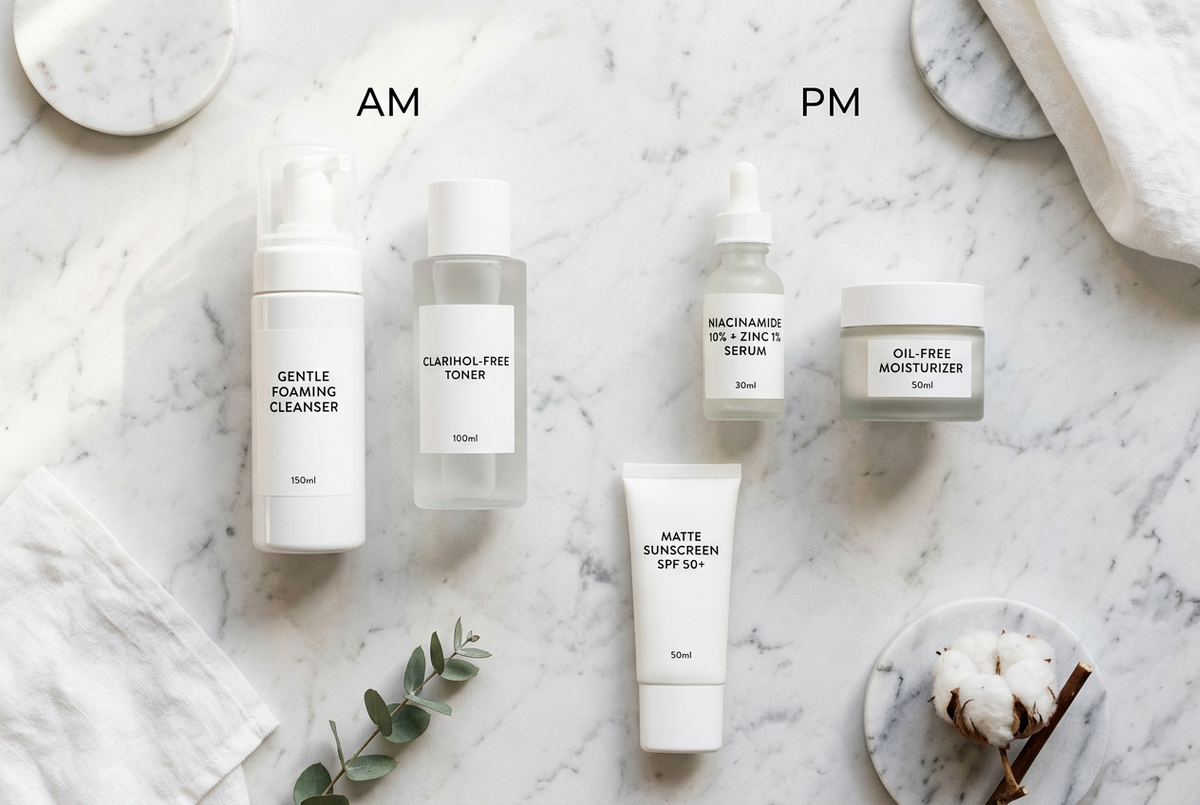
5. How to Build a Simple Daily Skincare Routine for Oily Skin
You don't need a complicated 10-step routine to manage oily skin.
A consistent routine with a few well-chosen products is often easier to maintain.
Morning Routine (AM)
Step 1: Cleanse
Use a gentle facial cleanser to remove overnight oil and impurities.
Step 2: Apply Targeted Treatment (Optional)
If your skin tolerates it, use a suitable niacinamide or other targeted treatment based on your concerns.
Step 3: Moisturize
Apply a lightweight moisturizer to maintain hydration and support your skin barrier.
Step 4: Apply Sunscreen
Finish with a broad-spectrum SPF 30+ sunscreen.
Evening Routine (PM)
Step 1: Remove Sunscreen and Makeup
Use an appropriate makeup remover or cleansing product to remove sunscreen, makeup, and daily buildup.
Step 2: Cleanse
Wash your face with a gentle cleanser.
Step 3: Apply Targeted Treatment
Use an exfoliating or pore-care product if needed. Avoid using too many active ingredients in the same routine.
Step 4: Moisturize
Finish with a lightweight moisturizer to keep your skin hydrated overnight.
Weekly Care
If your skin tends to have excess oil around the T-zone, consider adding a clay-based cleansing mask or treatment once or twice a week, depending on your skin's tolerance and the product instructions.
Avoid excessive exfoliation or frequent deep-cleansing treatments, as these may cause irritation.
6. Additional Tips to Help Reduce a Greasy Face Throughout the Day
Even with a consistent skincare routine, you may still experience some shine during the day. These practical habits can help:
Use Blotting Papers When Needed
Oil-blotting papers can absorb excess surface oil without requiring another full face wash.
Gently press the paper against oily areas rather than rubbing your skin.
Choose Makeup Formulated for Oily Skin
If you wear makeup, look for lightweight foundations and products designed for oily or combination skin.
A mattifying primer or setting powder may also help reduce the appearance of shine.
Avoid Touching Your Face Frequently
Your hands can transfer additional oil, dirt, and other impurities to your face.
Try to avoid repeatedly touching or rubbing your skin throughout the day.
Don't Overuse Oil-Control Products
Using multiple clay masks, exfoliating acids, and strong cleansers at the same time may irritate your skin.
A balanced routine is generally more sustainable than trying to remove every trace of oil.